
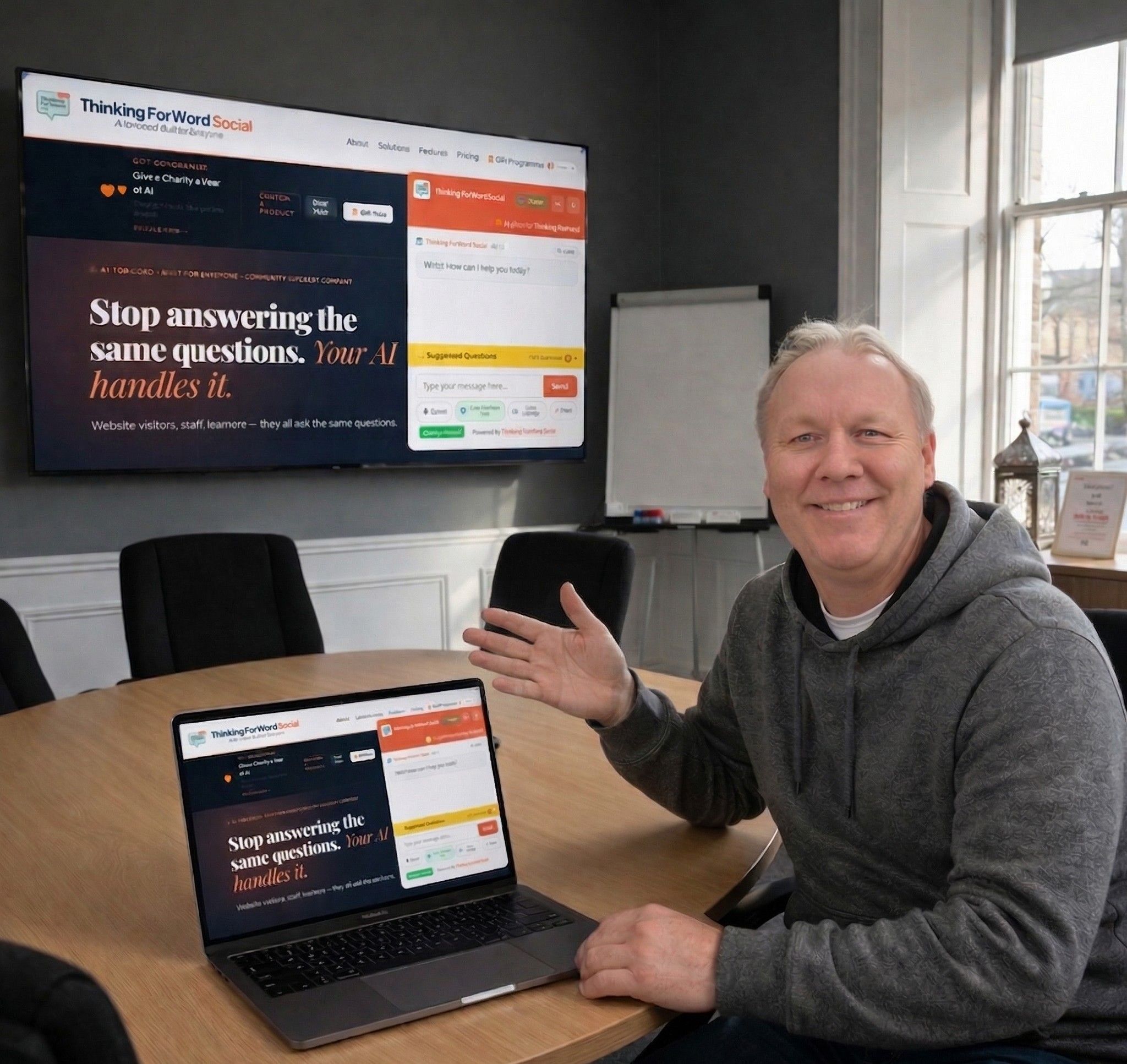
An Ayr-based Community Interest Company just went live on 1 April 2026 with a straightforward mission which is to bring proper AI tools to Scottish charities and community groups that have been priced out of the technology driving every other sector forward.
Thinking ForWord Social, founded by Colin Rodgers, launched offering two AI products built specifically for the third sector: a website assistant that handles visitor queries around the clock in over 16 languages with voice input and text-to-speech, and a Staff Knowledge Hub designed to cut the administrative load that consumes frontline workers' time. Both are delivered at 30–35% below commercial market rates.
The need is real and the numbers back it up. Scotland has over 46,500 voluntary organisations, generating a sector turnover of £9.2 billion, and more charities per head of population than any other UK nation, supported by around 1.3 million volunteers giving 126 million hours of support annually. These are not small operations on the margins, they are the fabric of Scottish community life. Yet the 2025 Charity Digital Skills Report found that 68% of small charities remain in the early stages of digital adoption, warning the AI boom could deepen existing inequalities unless targeted support is introduced. Nationally, 76% of UK charities are now experimenting with AI tools, up from 61% the year before, but only 2% are using them strategically.
That gap is exactly what Colin Rodgers is building into. "AI is moving fast," he said, "and the gap between what a well-funded organisation can access and what a small charity can afford is growing. We want to close that gap." The CIC Scotland structure is deliberate, with an asset-lock in place, a board constituted, and a Technology Licence Agreement signed, Thinking ForWord Social is set up so that any commercial return feeds back into the mission rather than out of it.
The practical impact is already visible. A staff member using the Knowledge Hub to pull together a detailed compliance report, the kind that typically consumed four hours, was completing the same task in around forty minutes. That is not a marginal efficiency gain. For an overstretched team at a food bank or a community development trust, it is the difference between finishing work and taking it home.
This sits squarely within a wider shift happening across uk tech. AI is no longer a conversation about what might be possible, it is a live question of who gets access to it and on what terms. A clear regional divide already exists, with economic hubs like London and Manchester reporting far greater AI familiarity and usage than other parts of the country, and digitally excluded people two to three times more likely to be unemployed according to Deloitte and the Digital Poverty Alliance. Scotland's voluntary sector sits in that gap. The organisations doing the most community-level work are often the least equipped to keep pace with the tools that would let them do it better.
The Scottish Government published its AI Strategy 2026–2031 just weeks before Thinking ForWord Social launched. It sets out a five-year plan to harness AI for responsible and inclusive growth, making a positive difference at every level of society, and delivery will be coordinated through AI Scotland, a new national programme involving The Data Lab, ScotlandIS, and enterprise agencies. The strategy is national-scale. Thinking ForWord Social is community-scale. Between them sits a large and largely unserved middle, the food bank with a broken website chatbot, the community trust whose staff are drowning in paperwork.
Colin Rodgers put it plainly: "I set up the CIC because I wanted to put that same technology in the hands of the people who actually need it most. There's a version of AI that works for a food bank, a community development trust, a small church with a busy social programme, and it doesn't have to cost the earth."
The CIC is currently focused on building its client base across Ayrshire North, East, and South, with a National Lottery Awards for All application in motion that would fund 20 AI assistants across 10 organisations. Longer term, a Gift Programme is planned, a mechanism for businesses and individuals to sponsor AI access for charities that cannot fund it themselves. It is one of the more practical models to emerge from the third sector's AI conversation: not a grant, not a pilot, but a structured way to make the technology self-sustaining within communities that need it.
Scottish tech has spent the past few years proving it can generate serious economic momentum. The next test is whether that momentum reaches the parts of Scottish life that are not measured in valuations, the volunteer coordinators, the community helplines, the overstretched charity staff who are, in many cases, the actual infrastructure of the places uk tech is so proud of.
Thinking ForWord Social is a small CIC from Ayrshire. But the question it is asking, who does AI actually serve, is one the entire sector needs to sit with.
Nothing to preview yet...
Commenting as guest. to reply and like comments.
No comments yet. Be the first to comment!