
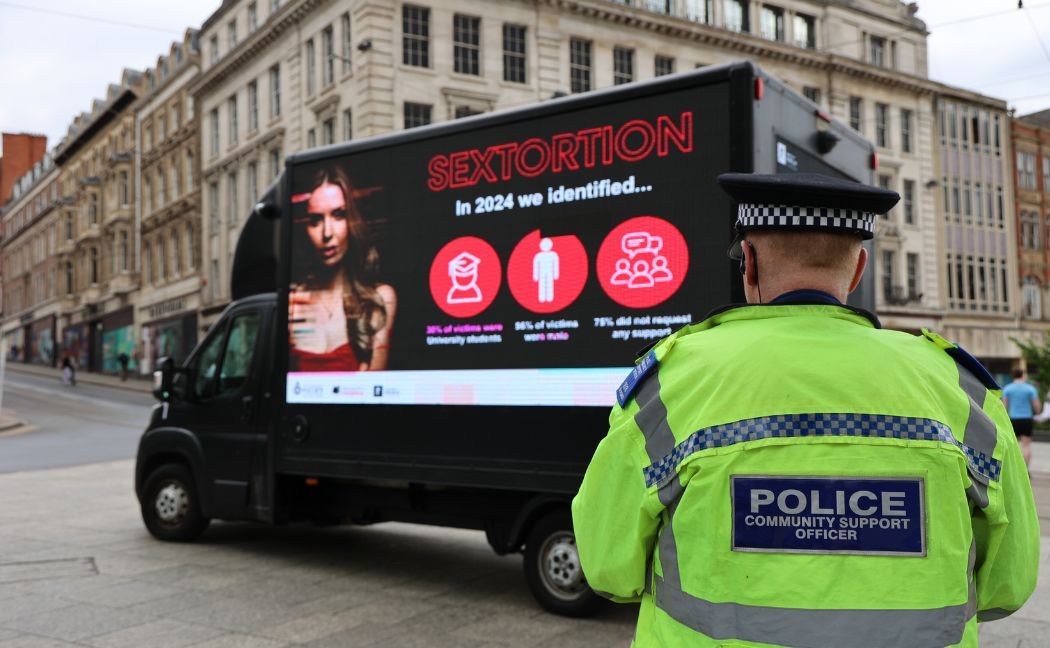
British children reported being blackmailed over intimate images at a record rate last year, and the numbers released this week make it impossible for the tech industry to look away.
New data from the UK's Report Remove helpline, published on 7 April 2026 by the Internet Watch Foundation (IWF) and NSPCC, shows the service received 1,894 reports from under-18s in 2025, up 66% on the year before. Of those confirmed by analysts, 34% involved online sextortion, up from 23% in 2024. That is nine reports a week from children being blackmailed, threatened, and coerced into silence on the very platforms they use daily.
The pattern is grimly consistent. Boys aged 14 to 17 made up 98% of reported sextortion victims. Criminals pose as peers, build trust quickly, extract intimate images, then turn those images into weapons, threatening to expose them to schools, parents, and social networks unless money is sent or more images provided. Kerry Smith, CEO of the IWF, described it plainly: "Criminals are casting their nets wide and are able to corner young people with the most violent and terrifying threats." The IWF has been clear that what is being reported is, as Smith put it, just the tip of the iceberg, many victims never come forward at all.
This is not happening in a vacuum outside of tech. It is happening inside it. The National Crime Agency has noted that sextortion victims are most commonly engaged on social media platforms preferred by young people, platforms that often have features creating favourable conditions for offenders, including easy fake account creation and access to victims' personal information and social networks. The NCA's CEOP Safety Centre received 380 sextortion reports in 2024 alone, with police forces logging an average of 117 monthly reports from under-18s in the first five months of that year. Tech-firm referrals for grooming to the US National Center for Missing and Exploited Children rose 192% between 2023 and 2024 to 546,000 reports, with around 9,600 of those originating from the UK in just the first six months of 2024.
The IWF is now pushing the government to mandate on-device nudity detection, technology built directly into smartphones from manufacturers like Apple and Google that could block children from sending explicit images in the first place. Hannah Swirsky, Head of Policy at the IWF, said: "We're calling on the government to take more steps, such as with on-device nudity detection and blocking. There are tools which can stop children from sending those images in the first place, if they've been groomed or coerced." Both Apple and Google already have communication safety alerts and sensitive content warnings in place, but child safety campaigners say those tools are falling well short of what is needed at scale. Swirsky was direct about what happens if the industry fails to self-regulate: "It is clear to us that if companies won't do this by themselves, the government must step in to make sure they do."
For uk tech, this is becoming an unavoidable compliance and reputational question. The UK's Online Safety Act is now in active enforcement, and in September 2025, Technology Secretary Liz Kendall announced that cyberflashing would be designated a "priority offence" under the Act, placing new proactive duties on platforms to detect and prevent it rather than respond after the fact. The Data (Use and Access) Act 2025, which became law in June, created a new criminal offence for making or requesting deepfake intimate images, and Ofcom is currently consulting on requiring platforms to use hash matching to detect and remove non-consensual imagery before it is ever posted. That is a technical ask with direct implications for how platforms are architected and moderated in the UK.
AI is making all of this harder. This surge in cases also ties into the wider regulatory push around uk ai safety, where policymakers are already tightening rules to protect children from emerging digital risks, especially those powered by AI and automated systems. In 2025, the IWF identified 8,029 AI-generated child sexual abuse images and videos, a 14% rise on the previous year, including a more-than-260-fold increase in AI-generated videos. Offenders are using generative tools to create abuse material from scratch, or to manipulate images of real children. The same AI wave that is driving uk tech investment and startup growth is also being exploited at the darkest end of human behaviour, and the regulatory environment is tightening as a direct result.
The human cost behind these numbers is real. Murray Dowey, a 16-year-old from Dunblane, was linked to online sextortion before his death. His family has since taken legal action against Meta, arguing the platform failed to put sufficient safeguards in place. They are not alone. Jess Phillips, the Safeguarding Minister, said the reality of children being driven to suicide over online sextortion scams "weighs heavily on me every single day." The UK government has also taken action against organised criminal networks behind these schemes, and as covered previously, UK government sanctions scam centers operating in Southeast Asia that have been linked to tech-facilitated financial crimes including sextortion, signalling a broader willingness to pursue these threats across borders.
What this means in practice for the tech industry is a regulatory squeeze that is only tightening. Platforms operating in the UK will face stronger duties around content detection, age assurance, and user safety by design, and the companies building the next generation of devices, messaging apps, and social products will need to treat child safety as a foundational engineering requirement, not an afterthought.
The data from Report Remove is updated annually. If the trend holds, the 2026 numbers will be worse. The window for voluntary action is narrowing fast.
Nothing to preview yet...
Commenting as guest. to reply and like comments.
No comments yet. Be the first to comment!